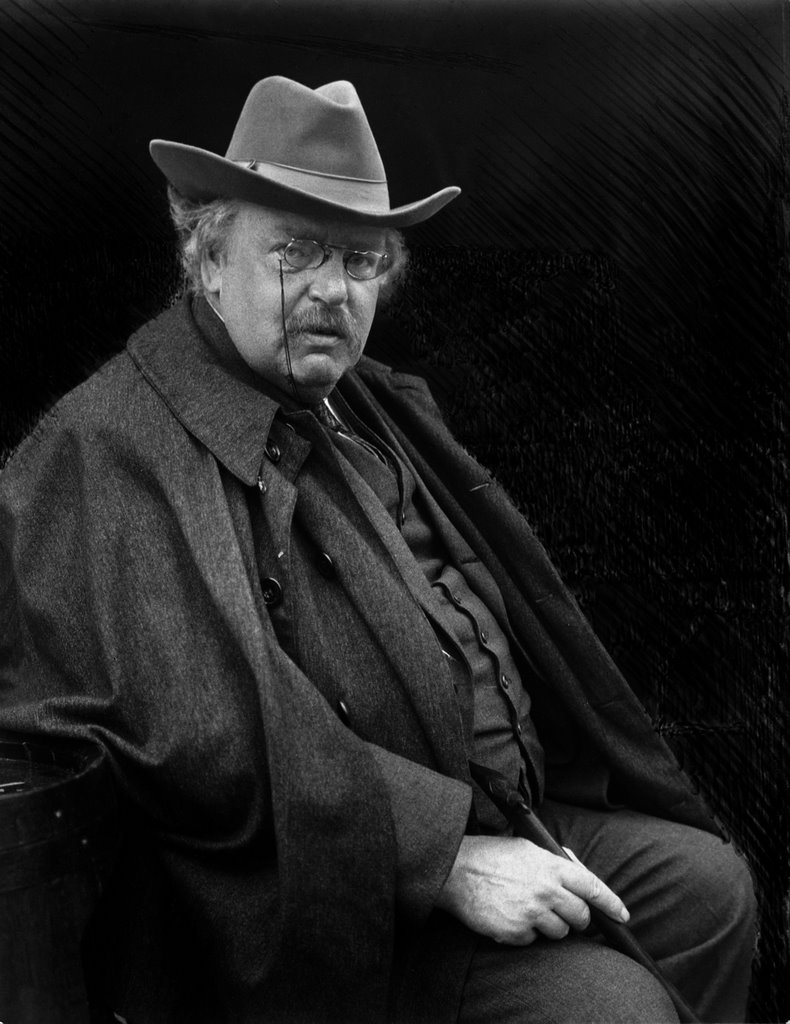
Monday, October 25, 2010

Homily 15: Life as Art (as preached by an orthodox rebel)

"Daniel purposed in his heart that he would not...." Daniel 1:8a

Life is like art: it involves drawing the line somewhere. The construction of ourselves and the shaping of our souls entails making true choices that result in solid stances. Going "with the flow," as an ultimate principle of life, is never a good idea. We can "flow" with peripheral issues, but at the center we must be stable. Without that central stability, we are no better than a wave caught in the winds (James 1:6).

Now, by "peripheral issues," what is meant is circumstances. In one sense, we can and should "flow" with circumstances in that we have no control over them: only God does. He constructs what we go through; what is left to us is how we go through it. It is that latter part that is central: when it comes to our environment, we must be as easy as a breeze; when it comes to the moments of choice, of character and holiness, of Christ-likeness (especially in the moments that we do not expect), we must be as solid as a rock.

Look at Daniel: He flowed with the peripherals of life. When the Babylonians came and took him as a child, he did not resist, nor did he fuss at being made a part of the king's court. However, he was solid on the essentials: "Daniel purposed in his heart that he would not defile himself." This instance is not unique. Look at Joseph: He did not resist his servitude and imprisonments, but he still fled from Potiphar's wife. What we see in these stories is a very difficult yet liberating truth: being a man or woman or principles does not mean a life of paralysis and petrification. On the contrary, without sure and settled principles, choices and actions are impossible. Without a fundamental understanding of where you stand and where you will and will not go, there is no possibility of any movement whatsoever. If the basic lines of your life are not set and stable, the there is no possibility of a picture.

-Jon Vowell (c) 2010


On the Errors of Optimism and Pessimism (a Gamgee philosophy explained by an orthodox rebel)

"Let the high praises of God be in their mouths and a two-edged sword in their hands...." Ps. 149:6
Christianity is neither optimism nor pessimism. It is neither naive nor cynical. It believes in goodness and worships the One who is Good. It also believes in evil and abhors the one who is Evil. There is never a case of extremism in this view. There is nothing of that obnoxious optimism, reeking of superficiality and ignorance, that reads so much good into everything that it sees nothing to fight about. And there is nothing of that pernicious pessimism, reeking of childish and condescending angst, that reads so much evil into everything that it sees nothing to fight for. Because such doctrines do not line up with reality, Christianity denies them both. The truth is that there is good in this world, and it is worth fighting for.

The world is growing weary of jesters and snobs. It grows tired of the infantile laugh of the optimist and the corrosive sneer of the pessimist. This is because the world is starving for Reality, for what is real and true, and neither optimism nor pessimism is either real or true; they do not deal with things as they are. Consequently, they have neither sword nor song for their journey, and such a lack will haunt them in the end. When the dark falls like a curtain and threatens what is true and good, they will have no means to engage it. Likewise, when the light shines like diamonds and beautifies all that it touches, they will have no means to express the fact. Only Christianity, treating both good and evil as true realities at their full capacities, puts a song on our tongues and a sword in our hands.

-Jon Vowell (c) 2010


Thursday, October 14, 2010

The Philosophical Fringe (a cultural engagement by an orthodox rebel)

The TV series Fringe is definitely the new X-files (except it's not as dark, and its lead character doesn't have the personality of a plank of wood). Since I'm more of a movie/animation man, I don't really watch it. My family does, however, and thus my DVR queue is plagued with various episodes of Abrams' and Carter's love child, robbing my of the pure aesthetic delights found in Whose Line is it Anyway? and Teen Titans. But I digress.

The current season has the main character, Olivia Dunham, trapped and confused in a parallel version of Earth. Due to a series of unfortunate and convoluted events, Olivia and her parallel self have switched universes: her alternative self works reconnaissance for her parallel universe boss while Olivia has been brainwashed into thinking that she is her parallel self and goes about living her (that is, the alternative her) life. Got it?

Of course, our stalwart (and rather lovely) hero can't stay trapped forever. Her old self keeps trying to break through, making her do little things that her alternative self wouldn't do. On top of that, her old life keeps visiting her in the form of hallucinations shaped like her friend (and new love interest) Peter Bishop. If your keyboard isn't soaked with the drool of intrigue by now, then that means that you still have a soul.

During one of her hallucinations, Peter tries to tell Olivia that she is not a part of this world and that she knows it. Olivia gives the typical denial response of "You're not real." To which, the quick-witted hallucination replies, "Reality is a matter of perception." That, apparently, is his metaphysical slam dunk, because Olivia has nothing to say back. End scene. End episode. I wonder what's gonna happen now, kids.

I really wish that Peter hadn't said what he said, because he didn't mean it. How do I know? Because if he meant what he said, then he wasn't making any sense. What he said was, "Reality is a matter of perception." What he meant was, "Reality is a matter of fact. Illusion is a matter of perception."

You see, Peter is trying to convince Olivia that what she thinks is real is not so; it goes against the facts, facts that are true and immutable. Her current "reality," however, is not based on the facts. It is based merely on her perception, which has been twisted and distorted, and thus is producing illusion. He is trying to get her to wake up from the illusion and back to reality.

Think about it: If Peter really meant what he said, then Olivia is doomed. If reality is only a matter of "perception," then reality is merely a matter of the mind perceiving it, which is to say that reality is only a matter of the individual mind. The source of reality (the logos, if you will) is your own mind. This kind of reasoning is called solipsism, and it is extremely dangerous. If reality is merely a matter of your own personal perception, then you are never in touch with reality (i.e., the facts); you are only in touch with your perception of it.

Furthermore, if you are only in touch with your perception of it, then you can never get outside of your perception to view actual reality and measure it against your perception to see if your perception stacks up to it. Thus, there is no way for you to know if your perception is the truth, i.e., if it conforms to the facts. You could very well be trapped (forever, I might add) in a world of self-created illusion. That is why it would spell doom for Olivia. There would be no escaping her perception, because she cannot escape her own mind.

Mere nitpicking, you say? Hardly. Peter Bishop is advocating reality over illusion. He is (in a sense) a visual demonstration of a solution to solipsism: if you are totally trapped away from reality, then the only hope for you is if reality comes to you. There are all kinds of philosophically Christian considerations in such a solution (viz., the Incarnation), as well as all kinds of virtuous thoughts (viz., reality is good and reality is attainable).

All of those thoughts and considerations, however, are lost under a pile of slip-shod writing. "Reality is a matter of perception" positively reeks of  post-modern sentimentalism and sloganeering. It communicates nothing of the hardy and proper philosophy that Peter is actually trying to convey. That is what annoys me. Something true and good was being presented, but it was lost. Its communication failed. In its place was an extremely noxious notion that exalts illusion to primacy and banishes reality to the fringe.

-Jon Vowell (c) 2010


Thursday, October 7, 2010

Salvation by the Sword (as written by an Original Orthodox Rebel)

The following is the September 24th entry in the Oswald Chambers devotional Daily Thoughts for Disciples. It is taken from Chambers' book The Philosophy of Sin. Here he says (in far better and simpler language) what I tried to say in this post.

The first thing in salvation is the element of destruction, and it is this that people object to. With this thought in mind, recall what our Lord said about His own mission: "Do not think that I came to bring peace on the earth. I did not come to bring peace but a sword." Our Lord reveals Himself as the destroyer of all peace and happiness, and of ignorance, wherever these are a cloak for sin.

It sounds like a startling and amazing thing to say that Jesus did not come to bring peace, but He said that He did not. The one thing that Jesus Christ is after is the destruction of everything that would hinder the emancipation of men and women. The fact that people are happy and peaceful and prosperous is no sign that they are protected from the sword of God. If their happiness and peace and well-being and complacency rest on an undelivered life, then they will meet the sword before long, and all of their peace and rest and joy will be destroyed.


Homily 14: On the Wilderness and Faith (as preached by an orthodox rebel)

"To Him who led His people through the wilderness...." Ps. 136:16a

The wilderness is not a fun place to be. It is the strenuous and expansive dry patch between the explosive bookends of the Exodus and the Promised Land. There are no  obvious mountaintop experiences; just meat and manna at the moments of crisis and unbelief. Patience will dry up like waters in the desert. A terrible restlessness and fear will strive to shake your soul apart: perhaps God made a mistake? Perhaps we should have stayed in Egypt: better to be in a stagnant stability than this howling emptiness. Therein lies the many dangers, toils, and snares. You are beset on every side by strange fire and foreign mistresses, tempting you with false hopes and homes. The vision of the Promised Land, so clear at one point, now feels like it was a generation ago. You're not even sure what you're doing anymore, and you are afraid. No, the wilderness is not a fun place.

It is also, however, an inevitable and necessary place. No high and holy vision or calling of faith comes without the suffering of its birth, and that suffering will always entail the testing of that faith. God will see your calling come to fruition, but only after you learn to fully let go and trust in Him, learn that things are only done by Him (Zech. 4:6), you can do nothing without Him (John 15:5), and it is He that will complete the work (Phil. 1:6). You cannot face the Promised Land with all its wars until you firmly stand upon the solid truth that says, "God is God and I am not." If you cannot trust God in the wilderness, then where can you trust Him? Certainly not when the pressure is on and the crises culminate into climax. We must let the wilderness take its toll. We are not fit for the future until we do.

-Jon Vowell (c) 2010


Thursday, September 23, 2010

On the Offensiveness of True Christian Living (as written by an Original Orthodox Rebel)

The following is the September 22nd entry in the Oswald Chambers devotional Daily Thoughts for Disciples. Though well known for his popular devotional My Utmost for His Highest, many remain unaware of the bulk of Chamber's teachings (almost all about Christian living), found in some 30 books produced from his writings and lectures. Because of this, Chambers is ironically the best kept secret of Christianity. The following devotional entry is actually an excerpt from his book The Servant as His Lord.

When the Spirit of God comes in, we begin to realize [that] everything that is not of God has to be turned clean out. People are surprised and say, "I was told God would give the Holy Spirit to them that ask; well, I asked for the Holy Spirit and expected that He would bring me joy and peace, but I have had a terrible time ever since." That is the sign that he has come. He is turning out the "moneychangers and the cattle," the things that were making the temple [i.e., your body] into a trafficking place for self-realization.

We soon find why the gospel can never be welcome. As long as we speak winsomely about the meek and gentle Jesus and the beautiful ideas the Holy Spirit produces when He comes in, people are captivated, but that is not the gospel. The gospel does away with any other ground to stand on than that of the atonement. Speak about the peace of heaven and the joy of the Lord, and people will listen to you; but tell them that the Holy Spirit has to come in and turn out their claim to their right to themselves, and instantly there is resentment: "I can do what I like with my body. I can go where I choose."
 
The majority of people are not scoundrels and criminals, living in external sin. They are clean-living and respectable, and it is to such that the scourge of God is the most terrible thing, because it reveals that the natural virtues may be in idolatrous opposition to God.


Wednesday, September 22, 2010

Time and the Engineering of God (the musings of an orthodox rebel)

"Arise, shine...." Is. 60:1

What are you doing with the time that you have been given, with the moments that God has engineered in your life? I am not talking about some general, abstract sense of "your life," but rather your immediate circumstances, the here and now. Are you filling up these current moments with what God has given you to do (no matter how great or small), or are you wasting time by moping and whining about what "should" or "could" be (or even what will be)? When it comes to practical energies and endeavors, "should" and "could" are always a snare. When action is called for, it is no good to suddenly deliberate about whether or not circumstances should or could be better and subsequently whether or not your efforts will succeed. Such concerns will leave you paralyzed, and thus make the here and now even more frustrating. You must not fix your focus on the formless future; keep it on the present moment with its more defined lines and edges. Keep your energies on the right now where you can actually do something (even small things); tomorrow is none of your business (Matt. 6:34). Most importantly, keep your eyes on God, on His presence and promises.

What glorious wasters of time we are! God has called us to a specific purpose. He then engineers our immediate circumstances to aid (in some way) in that purpose. However, we wrongly consider our circumstances. We see them as a detriment to God's purpose, or we don't see them at all and thus don't capitalize on them. In either case, we have set our gaze on some imagined future situation that we feel we must wait for, and as a result we get stuck in the mud. "Oh, but I must wait until this or that falls into place before I can do anything." If you don't start doing something(s) now in the small and quiet moments, then you will surely do nothing when ideal circumstances come, if they come at all. "Oh, but what's the point? I am not doing anything that matters right now." If that is so, then it is because you are not doing it. Everything in our lives is engineered by God to fulfill His purpose in our lives (Rom. 8:28). If you say that you believe that, then what are you doing with the current moments that you have been given? How are you using the tools at your disposal, even (and especially) the small or strange ones? If you are blessed right now with inordinate free time, are you filling it up on some level with what you are meant to do? If you are in odd or hard circumstances right now, what are you learning? Are you learning? Or are you filling up your time with nothingness while you simultaneously cry about the nothingness?

Epithet: Do not waste one drop of time that God has given to you. It was given for a reason.

-Jon Vowell (c) 2010


Homily 13: On the Righteous and Awakening (as preached by an orthodox rebel)

"Unto the upright there arises light in the darkness...." Ps. 112:4a

The righteous life is not a matter of smug piety and self-satisfaction; rather, it is a matter of seeing things as they are. The whole world lies in darkness, and fallen humanity stumbles about. The redeemed of the Lord are simply those whom light has shined upon, and now they can see. Their walk is now marked with flashes of realization and awakening. Reality becomes clearer and clearer. At long last, what's truly important can be clung to, what's non-essential can be held loosely, and what's evil can be properly abhorred. Where once we could only make half-guesses and hope for the best, now we receive true knowledge. Where once we were blind, now we see.

This clarity is not absolute and instantaneous. Reality is not comprehended in an instant nor in entirety. How can it be? God is Reality, the most real, and He is beyond absolute comprehension (Rom. 11:33). The righteous life does not mean an end to mystery. What it does mean is that "there arises light in the darkness," momentary yet momentous illuminations that give us the clarity that we desperately need at that moment. For now, we know in part; one day, we will know in full (I Cor. 13:9-12). Until then, let us praise the God who lights our night with His presence and truth, the God who is "gracious and full of compassion and righteousness" (Ps. 112:4b).

-Jon Vowell (c) 2010


Wednesday, September 8, 2010

How Journalism Misses the Point (a prophetic aside by an Original Orthodox Rebel)

The following is from chapter 4 of Chesterton's novel The Ball and the Cross:

It is the one great weakness of journalism as a picture of our modern existence that it must be a picture made up entirely of exceptions. We announce on flaring posters that a man has fallen off a scaffolding. We do not announce on flaring posters that a man has not fallen off a scaffolding. Yet this latter fact is fundamentally more exciting, as indicating that that moving tower of terror and mystery, a man, is still abroad upon the earth. That the man has not fallen off a scaffolding is really more sensational; and it is also some thousand times more common. But journalism cannot reasonably be expected thus to insist upon the permanent miracles. Busy editors cannot be expected to put on their posters, "Mr. Wilkinson Still Safe," or "Mr. Jones, of Worthing, Not Dead Yet." They cannot announce the happiness of mankind at all. They cannot describe all the forks that are not stolen, or all the marriages that are not judiciously dissolved. Hence the complete picture they give of life is of necessity fallacious; they can only represent what is unusual. However democratic they may be, they are only concerned with the minority.


Saturday, September 4, 2010

On Despairing in a Bookstore: Prose Edition (the musings of an orthodox rebel)

(Note: Find and read the poem editions here and here.)

"Give us help from trouble, for vain is the help of man. Through God we shall do valiantly, for it is He that shall tread down our enemies." Ps. 108:12-13

I have often found bookstores to be terrifying places. Apart from being black holes for a certain unnamed blogger's time and money, they can create an overwhelming sense of smallness. Within those wooden halls (whose walls are bleached with the stench of coffee), there is a seemingly infinite amount of thought and opinion floating around, coalescing together into a monstrous edifice of worldly wisdom and consideration. Before such a modern tower of Babel, one can feel extremely tiny and alone. I am not referring to that childish notion about how your individual beliefs could possibly be true before such a saturated intellectual marketplace (for mere vast numbers of counter claims and opinions do not negate the truthfulness of any one idea). What I am referring to is a sense of impotence and hopelessness before it all: even if what you believe is true, what does it matter? The sea of human opinion is vast and varied beyond any possible charting. How can you possibly hope to make any noticeable dent in it?

As already stated, this is not a problem with unbelief but rather despair. If you lose faith in one belief, then you can (and will) exchange it for another and move on with your life. If, however, you still have faith but feel as though it is faith in a lost cause, then what can you do? You know that Christ alone has the words of life, and thus there is really nowhere else to go (John 6:67-68); yet the darkness around your little circle of light seems impenetrable, an unholy mountain range of impassable crags and impossible caves. In short, you have great faith in what you believe but no faith in making it matter. Any and every escapade into the dark seems a frustrating failure, leaving you to "reel to and fro, and stagger like a drunken man" until you are "at [your] wit's end" (Ps. 107:27). Your feelings of smallness and loneliness are confirmed, and they spill over into feelings of uselessness, with all ending in despair.

It is at these points of desolation and discouragement that we must remember: "vain is the help of man," including ourselves. If we are despairing right now in the face of looming and accumulated public thought and opinion, then it is because we see the fight as ours and not God's. It is through Him and Him alone that "we shall do valiantly." I am not saying that we will knock the whole giant monolith of counter/non-Christian opinion over in a night (nor am I not saying that). What I am saying is that whatever our impact upon it (be it great or small), it will only come through God, not us. There is a thing that He has given each of us to do, some sharp sword to stick in the side of the spirit of the age and the prince of this world, a sword specific to each of us. If we see that sword as a matter of our own strengths and abilities, then we will feel smothered beneath the shadow of the world. However, if we "seek the Lord and His strength," then we will rejoice (Ps. 105:3-4) and go singing into the dark.

Epithet: Let the unquenchable joy of the Lord be your strength and His unconquerable strength be your joy.

-Jon Vowell (c) 2010