Showing posts with label Art. Show all posts

Wednesday, April 24, 2013

Staying-Power (thoughts on music and art)

I have heard from some that "Christian" music is going through a kind of renaissance. The days of crappy pop-culture cloning are dying out, being replaced slow but sure by more substantive musical art. Such a sentiment may be overstating things a bit, but it's not completely without merit. Mainstay and mainstream juggernauts like Anberlin and Switchfoot have carried that torch for the past ten years or so (though the latter has begun to show signs of wear and tear), and current big timers like Mumford and Sons and hidden gems like My Epic cannot help but feed the excitement that the dark ages of CCM are finally fading away.

Like I said, it's overstated. Pop-culture is big business, and "Christian & Gospel" is one of the biggest money-mongers around. Chris Tomlin and WOW Worship aren't going anywhere, and mainstream Christianity's seemingly incurable drive to ape the world and its culture will continue to be an ever-present source of parody and scorn.

But my point here is not to comment on the current state of so-called "Christian" music, but rather to point out how unpredictable it can be. Junk and jewels often get spewed out in the same breath, and there can be diamonds amongst the rough, rough sewage that passes for "Christian" "art". This is a fact no matter what day it is or what generation of music (or film or literature or whatever) we're going through. The dark ages can still produce a Beowulf, and the latest generations can still produce horrors to the ears and eyes.

Case in point, I have two songs to share with you. One is "Light Up the Sky," a single released in 2010 by The Afters (your obligatory generic Christian band). The other is "Calling Out Your Name" by legendary CCM icon Rich Mullins. Let's deal with "Light Up the Sky" first. Regardless of your musical taste, try and listen carefully:


Now, look: I do not in any way question these guys talent or sincerity, and since I believe that God is big enough to use any and every thing for His glory, I don't even doubt the song's ability to touch people. (Its official music video is actually quite inspiring.)

Having said that, be honest with yourself: they sounded like The Backstreet Boys, didn't they? (Seriously, when the chorus hits and they do the "light, light, light"/"I, I, I" thingy, try some choreographed hand gestures. It totally works.) It's fluffy, it's predictable, it's safe, it's...fine. Really fine, mind you, but just fine. It came out two or three years ago, and you've probably never heard of it, since it is not built to last. Canned pop-art is never built to last; when it ever does, it was an accident. Their primary purpose is to be disposable and replaceable.

Again, this does not mean that they weren't fun in their day, but it does mean that there is nothing everlasting about them. And the sign of good art (in any medium or genre) is that it has something everlasting about it. It has "staying-power" across generations. Shakespeare was said to be "not of an age but for all time," and guys like him and Mozart remain, not because dead white guys shove them down our throats forever. How can they (being dead white guys, after all)? Rather, it's because they have staying-power: they resonant down through the ages.

Compare and contrast that song with this one by Rich Mullins. It first appeared in 1991, during the early heyday of CCM. I would argue that while both this and "Light Up the Sky" are perfectly legitimate works of art, there is something inherently different about Mullins', and that difference is its eternal nature. It has staying-power. What it says, how its says it, how the whole composition rolls and rides through the soul like the wind and the waves...it's truly a transcendent experience. There is a reason this song (and other Mullins songs) still speaks while others (though well-intended) fall silent in the end. It's because he's singing to touch eternity, while everyone else just seems to be living for the moment.

See what you think:


-Jon Vowell, et. al. (c) 2013


Monday, November 12, 2012

A Hymn of Trees (poetry by an orthdoox rebel)

And now a return to calmer waters, as well as a return to something I haven't posted for a while. Enjoy.

 
I see shaggy cypress, hard-hided oak,
Smooth-skinned maple, silver or red,
With timid poplar resting in between.

Leaves folded over one-by-one,
Laying like coats of emerald armor,
Rattling their scales and sabres
As the wind winds through them
Like threaded needle through a cloth.

The fabric of forestry, woven tightly together
By the unseen force and feeling
Of the wind.

-Jon Vowell (c) 2012


Wednesday, October 10, 2012

Live Law (as explained by an Original Orthodox Rebel)

The following is from George MacDonald's essay "The Fantastic Imagination," and it is meant as a postscript to yesterday's post:

A man's inventions may be stupid or clever, but if he does not hold by the laws of them, or if he makes one law jar with another, he contradicts himself as an inventor; he is no artist. He does not rightly consort his instruments, or he tunes them in different keys. The mind of man is the product of live Law: it thinks by law, it dwells in the midst of law, it gathers from law its growth; with law, therefore, can it alone work to any result. Inharmonious, unconsorting ideas will come to a man, but if he tries to use one of [them], his work will grow dull, and he will drop it from mere lack if interest. Law is the soil in which alone beauty will grow. Beauty is the only stuff in which Truth can be clothed; and you may, if you will, call Imagination the tailor that cuts her garments to fit her....

Thursday, December 22, 2011

In Defense of Damsels and Bumpkins (as explained by an orthodox storyteller)

The two most important and vital elements to any good fairy-tale (indeed, to any good story) is the damsel and the bumpkin, and yet never have two things been more derided in our time. There is something offensive in the former and silly in the latter.


The damsel is offensive because we live in an enlightened age of unquestioned feminism, wherein women have been set free from the chains of home and hearth to cheerfully wear the chains of 9-to-5 corporate life. The bumpkin is silly because that's what a bumpkin is: a laughable and occasionally lovable oaf who deserves no more attention and serious praise than a newborn child. In the end, we worship amazonian bravado and scorn the loveliness of the princess; we condescendingly pat the good-natured fool on the head and laud the antics of the antihero. It is exactly these modern notions that good fairy-tales turn upside-down.


Such a turning is very much needed today. In fact, it should be called a returning, for I am not saying anything new, just everything that people have forgotten. For example, nobody appreciates a "damsel in distress" anymore. They assume that there is something demeaning in the whole affair, that women are somehow reduced to impersonal narrative furniture to be forcibly passed about like a brain-dead hot potato amongst men of varying moral aptitudes. The underlying assumption is that a damsel is always "distressed" because they have nothing better to do, i.e., because they are utterly useless, a mere plot foil and no more.

Such is the cynicism of our age, but even a moment's consideration on the issue will reveal its logic to be complete nonsense. If a damsel is "utterly useless," then why is she distressed? If she has no qualities of worth or value, then why would anyone bother their heads about her at all? Why is so much energy and time and military expense wasted by the villain on her capture, and why is so much toil and sorrow willfully suffered by the hero on her rescue? If she had no other purpose and point than to be moved from the Castle of Syrupy Light to the Dungeons of Stygian Slime and then back again, if her only purpose is fundamentally logistical, then why all the fuss? Surely dark lords and wandering knights (and enraptured readers) have better uses of their time.

The simple answer is that the damsel is not "useless". It is her very "use" that makes her the focus of the whole affair. What people seem to forget (and rabid feminists are loath to remember) is that the princess is the point of the fairy-tale. True, the bulk of the narrative is spent on her rescuer (a much maligned individual whom we will address in a moment), but that is because his energies (or even her energies, as in the tale of Britomart) are solely pointed towards her. Look at any great tale that involves "damsels in distress" and you will see that the princess is the most vital person on the planet. It is she who will stop the lords of shadow from enacting the great woe. It is she that will guarantee the downfall of the Abyssal King. It is she who will bring the return of the dawn and the dancing of the daffodils, and the puppies and kittens will dance together again. In short, it is she who will bring about some great thing in the larger picture of the world, and it is for that very reason that the darkness seeks to ensnare her. She is always the true threat. She is always the real hero.

This should not be surprising to any of us. The "hero" who rides to the rescue is not the ultimate hero. The princess is, and whatever heroics the "hero" has are derivative from and dependent upon her. The truth is that the "hero" (whoever he/she may be) is trying to rescue the princess because there is some greater feat to be done that only the princess can do and which, consequently, the "hero" cannot do, which is why she must be rescued. She is the vital piece. That is why so much energy is expended on her. That is why chivalric codes have been inspired by her. That is why a certain popular video game franchise is called The Legend of Zelda and not The Legend of Link. The princess is everything, the central force to the narrative centrifuge.

Even the exception proves the rule, i.e., the case of dragons kidnapping the princess. She may not have been "distressed" because of some great "thing" that she can "do", but remember what a dragon is. They represent horrible, voracious greed, a living void of endless consumption. They are hoarders, gluttons; their lairs are full of precious things, including the most precious of all: the princess. Those stories strike us the hardest, because now the damsel is rescued, not for her use, but for herself, which is the point all along. She is the most valuable one, and when that which is most valuable is imperiled, someone must take up the sword.


Of course, the one who takes up the sword is never who we expect, and that is yet another point of the fairy-tale. When the most valuable and precious one is imperiled, it is not the brawniest of knights who ultimately wins her back. Rather, it is the bumpkin who gets called kicking and screaming into the fray. In the end, it is Samwise, and not Gaston, who gets called to the rescue. This is the other vital element, viz., the hero is a bumpkin. The hero is a bumbling, lovable fool who would much rather stay at home and yet has enough good-heartedness to not leave a friend in the lurch. In short, the hero is "normal," and yet is called to the extraordinary.

This is a tale as old as time. It was not the warrior sons of Jesse who slew Goliath. It was his youngest, a shepherd boy, who had no sword to call his own. It was not a great and legendary fighter who brought an end to the wrath of Grendel and his mother. It was Beowulf, who was considered "the least amongst his brethren". It was not Eric the golden knight who slew Bavmorda and saved the baby Elora. It was Willow Ufgood, the farmer, father, and dwarf. It is the "least" who rescues the highest. It is the poor lost poet in the woods who descends through hell so that he may ascend to heaven. It is the last who becomes the first. The bumpkin is our hero. The least of these are our champions, and their trophies are innumerable, from dragons and demons to even death itself, for when God raised his glittering sword against our last enemy, he did not come riding on the white horse of the apocalypse, but on the red cross of the Romans, dying in ignominy and infamy, raising all to newness of life, and hallowing the fool forever. For God has chosen the foolish things to confound the wise, and the weak to overcome the strong.

Herein are the two vital elements of the fairy-tale: the damsel and the bumpkin. And herein lies their vital lessons. In the damsel we see this, that the most valuable and precious thing in the world is a woman. In the bumpkin we see this, that even the smallest of persons can change the course of history. Such things get lost on the majority of us today. All of our modern day "heroes" are pathetic, paltry things: sneering antiheroes with the likability of a dead toad, and sarcastic amazons whose entire femininity has been disemboweled. We waste our time on things not worth a sneeze, and yet at our fingertips are the two great inspirations of the world: the beauty and power of the princess, and the stout, fear-soaked courage of the bumbling fool. If our stories could only learn to bask in the splendor of that double-edged humility, perhaps we could find ourselves wanting more than the barren wastes of our modern mythologies.

-Jon Vowell (c) 2011


Wednesday, August 31, 2011

The Courage to Do (as explained by an Original Orthodox Rebel)

The following is from p. 218 of Oswald Chamber's The Moral Foundations of Life:

An artist is one who not only sees, but is prepared to pay the price of acquiring the technical knowledge to express what he or she sees. 'Artistic people' are those who have not enough art in them to make them work at the technique of art whereby they can express themselves; they indulge in moods and tones and impressions. Consequently, there are more artistic people than there are artists. The same is true of poetry. There are many people with poetic notions, but very few poets. It is not enough for people to feel the divine flame burning in them; unless they go into the concentrated, slogging business of learning the technique of expression, their geniuses will be of no use to anyone.

Apply these illustrations spiritually: if we have not enough of the life of God in us to overcome the difficulty of expressing it in our bodies, then we are living impoverished spiritual lives. Think of the illuminations the Spirit of God has given you. He expected you to bring your physical body, that He made, into obedience to the vision, and you never attempted to but let it drift, and when the crisis came and God looked for you to be His mouthpiece, you crumbled all to pieces. You had not formed the habit of apprehending; your physical machine was not under control. It is a terrible thing to sit down to anything.

Beware of being sidetracked by the idea that you can develop a spiritual life apart from physical accompaniments. It is a desperately dangerous thing to allow the spiritual vision to go ahead of the physical obedience.

Thursday, August 11, 2011

Mozart Metalheads (musical musings by an orthodox rebel)

It is amazing what human beings can do with music, not just the musical pieces themselves but also what can be done with those pieces. A piano piece can be played on the guitar, which can be played on the violin, which can be played on the xylophone, which can be played on a piccolo. Something loud and thunderous can be made soft and gorgeous while something contemplative and quiet can be made into a rock ballad. The expressive possibilities seem endless, and they can be quiet fun to explore, though the exploration can produce some surprising results.

I once heard someone (some anonymous voice in a comment section somewhere) say that the musical style of "metal" lends itself well to classical interpretation. Simply put, those shredding guitar rifts and heavy-handed back-beats can be quite effectively transposed into a string ensemble. I have found (from random suggestions and searches on iTunes, Facebook, and Youtube) many "tribute" albums to various bands where all of their songs were played on the piano (or a violin and piano, or with a string quartet), and I had seen many of those albums pay tribute to "metal" bands as well. Thus, the assertion did not surprise me.

Recently, however, I was visiting a blog that I frequent often. Every Monday it posts something about music, and this Monday it had a professional video from a concert for a band called Apocalyptica. They are a Finnish metal band that specializes in something called (brace yourself) "cello metal". That's right: cello metal. Three out of the four members are classically trained cellist (and the fourth one can play one as well), and they make their cellos the centerpiece of their act. As proof of this, I present to you the video from that blog, and I want you to pay attention to this video. Nevermind that the four men on stage look like a typical "metal" band (i.e., they're aptly dressed for Halloween, and one's missing his shirt), or that the stage looks like it is set for a "metal" band (complete with skulls!). Instead of all that, pay attention to these two things: 

(1) The song itself. It is a rendition of "Nothing Else Matters," by Metallica (I've linked to the song in case you want to listen to it for reference). I've randomly heard this song before (on Pandora Radio), and it sounded like a typical metal song I suppose (my experience is very limited); but I've never heard it done like this before. Apocalyptica takes it and transposes it into a cello quartet piece that is (no joke) hauntingly beautiful. It sounds like something any Mozart-purist would be in tears over. Listen to that and then think: that used to be a metal song by Metallica. Amazing.

(2) The people in the audience. "Metalheads" one and all, yes? Perhaps, yet when the classical sounds begin to resonate from the stage, there is no chorus of boos or chants of "BORING!". They are all into it. Seriously into it. I don't know why, but I found that to be pleasantly surprising (which I fear means that I am a snob).

Anyway, check out the video and see what you think:


-Jon Vowell (c) 2011


Friday, June 10, 2011

"We all go into the dark...." (critical engagement by an orthodox rebel)

This article by The Wall Street Journal was very interesting. Read it carefully before proceeding.

I wish to divulge a certain truth about myself: when it comes to fiction (and even real life), I like dark things. I like well crafted villains and situations of true peril. I like watching the hero struggle (victoriously, of course) through a dark night of the soul, culminating in new strength and resolve. I like evil, death, sorrow, and the like treated with a sense of respect and maturity. As I've pointed out elsewhere, the more seriously you take evil, the more seriously you take the good. The inkier the darkness, the more brilliant the light.

On the other hand, as Mrs. Gurdon points out in her article, dark things (like all good tools) can be abused. What I want to assert, however, is that what she has pointed out is not true "dark" fiction but rather a childish parodying of it. What she is pointing out is not darkness; it is depravity, and the authors involved ought to be ashamed for exposing children to such things. I applaud Mrs. Gurdon for exposing these travesties of fiction and their collective assault on the moral character of young adults and teenagers. However, for the sake of all things truly "dark," I feel compelled to try to offer (in a limited way) some parameters for what truly defines something that is "dark." I believe it involves at least two things.

First of all, anything that desires to call itself "dark" must have a sense of gravitas. I do not mean mere weight, nor do I mean boredom or pretentiousness, but rather a sense of seriousness. As mentioned earlier, there is a certain sense of respect and maturity given to the content of the story, all of the content (both the good and the bad). It is treated with gravity, not levity, nor is it treated flippantly, as though it didn't matter. The mark of any great piece of fiction (whether it be dark or not) is that it treats its content like it matters. It knows nothing of shock and titillation; only seriousness. When an author writes about our protagonist seeing a wall "covered with impaled heads and other dripping, black-rot body parts: hands, hearts, feet, ears, penises," I cannot take such a sentence seriously. It has no gravitas; it is simply gross. Gruesomeness does not equal seriousness, and anything that is truly dark has first and foremost a sense of seriousness about its contents.

Second of all, anything that desires to call itself "dark" must have a sense of somberness about it. If my first point stressed gravity, then this point is stressing tragedy. This is where most so-called "dark" stories miss the mark. They focus on the disgusting and the gross rather than the tragic; they expose the depravity rather than contemplating the tragedy. The problem with this is that depravity (aside from being repulsive and corrupting) has only superficial narrative power. Tragedy, however, has fundamental narrative power. It strikes deeper and last longer and is far more meaningful. Going into graphic detail about how some poor girl has sliced her arm "to ribbons" has no lasting power over the reader. It may shock and disgust you. It may haunt your brain as an image, but it has no fundamental effect on you. It has not changed your mind about anything, nor has it stirred you towards any physical or moral action (except, perhaps, buying a different book). What has been missed is that the cut arms of the girl are not nearly as potent as her cut soul, the latter being a far more universal (and thus relevant) reality than the former. Not everyone cuts their arms when they are sad, but everyone has been sad; and that which is truly "dark" focuses on that universal quality of sadness, on the underlying tragic elements of our lives.

A clarifications is in order. By "somberness" or tragedy, I do not mean merely a perpetual state of angst or ennui. A morbidly depressed character is not "dark"; they are just morbidly depressed. For a character to be "dark," they must be caught in the grip of tragedy, and either are struggling against it towards catharsis (if they are the hero) or have succumbed to it (if they are the villain). Sadness can never be the end unto itself, for that is the way of the villain. There must be a light at the end of this dark tunnel, but you have to go through the dark tunnel first.

That last sentence may strike some as odd (or old fashioned), but I claim it as the undeniable truth of true "dark" fiction, i.e., it is meant to offer us hope. As stated earlier, the darker the dark, the more stunning and sudden the light becomes. "Dark" fiction (perhaps more than any other fictive style) has this potential to make the light explode before us like a thousand symphonic stars, and it does it in this way: by taking us honestly and seriously through the dark. In perhaps the wildest of paradoxes, the authors that Mrs. Gurdon cites focus so intently on the dark that they cease to be dark at all; they become disgusting and depraved, mere repositories of vapid shock and titillation. For without light, darkness loses all meaning.

Jon Vowell (c) 2011


Thursday, April 28, 2011

Creative Fantasy vs. the "Morbid Delusion" of Post-modernism (as explained by an orthodox rebel and an Original Orthodox Rebel)

Post-modernism, in its denial of any ability to know truth, likes to languish in the ironic, absurd, and downright ludicrous. This can sometimes produce fun things (e.g., some absurdist plays can be quite humorous, and post-modern architecture is cool to look at), but more often it produces vacuous, insane, and perverse creations that leave the mind and soul empty and reeling (e.g., David Lynch's Eraserhead is exactly as he described it: "a dream of dark and terrible things"). Regardless of the result, the premise is always the same: art cannot take us to truth.

In general, post-modernists insist that art is to have no relation to truth of any kind, except for the "truth" of the artist. It is their perspective that is on display, and they may represent it however they choose (even if it is in a manner that completely destroys any real communication of that perspective). They claim that this is the true freedom inherent in art, i.e., the freedom to transgress beyond all limitations and boundaries, from absolute truths to even the canvas itself.

A counter-position to the post-modern notion of "art unlimited by truth" is here articulated by J.R.R. Tolkien in his famous essay "On Fairy-Stories". In one section (quoted below), Tolkien counters the claim (held by the modernists of his day as well as the post-modernists of ours) that the genre of "Fantasy" necessarily implies a lack of or even antagonism towards "Reason". Instead, he postulates a radical alternative: when reason fails, fantasy perishes; for fantasy is based upon a certain kind of deviation from the truth, but that deviation is not possible unless you first know what the truth is. 

An example is needed. A pilot cannot "deviate" from his "flightpath" without (1) there being a flightpath (2) that he can reference and (3) is fixed. If the flightpath is inaccessible knowledge for the pilot (either by accident or ignorance), or if it is not fixed but is changing to a different direction every second, then the concept of "deviation" disappears. Any direction chosen could as well as be a flightpath as well as a deviation. Thus, a fixed referent is necessary even for defying it, for sin is dead without the law (Rom. 7:8). Unknown and unknowable truths produce no rebellions, for the rebels could never know what they were rebelling against.

-Jon Vowell (c) 2011

(The following excerpt can be found on pp. 144-45 of The Monsters and The Critics: And Other Essays.)

Fantasy is a natural human activity. It certainly does not destroy or even insult Reason; and it does not either blunt the appetite for, nor obscure the perception of, scientific verity. On the contrary. The keener and the clearer is the reason, the better fantasy will it make. If men were ever in a state in which they did not want to know or could not perceive truth (facts or evidence), then Fantasy would languish until they were cured. If they ever get into that state (it would not seem at all impossible), Fantasy will perish, and become Morbid Delusion.

For creative Fantasy is founded upon the hard recognition that things are so in the world as it appears under the sun; on a recognition of fact, but not a slavery to it. So upon logic was founded the nonsense that displays itself in the tales and rhymes of Lewis Carroll. If men really could not distinguish between frogs and men, fairy-stories about frog-kings would not have arisen.

Fantasy can, of course, be carried to excess. It can be ill done. It can be put to evil uses. It may even delude the minds out of which it came. But of what human thing in this fallen world is that not true? Men have conceived not only of elves, but they have imagined gods, and worshiped them, even worshiped those most deformed by their authors' own evil. But they have made false gods out of other materials: their notions, their banners, their monies; even their science and their social and economic theories have demanded human sacrifice. Abusus non tollit usum [Latin: "Abuse does not take away use."]. Fantasy remains a human right: we make in our measure and in our derivative mode, because we are made; and not only made, but made in the image and likeness of a Maker.


Monday, March 7, 2011

"Gloriously Wasteful" (stanzas for artists by an Original Orthodox Rebel)

The following stanzas are taken from the March 2nd to 5th entries (pp. 30-31) in George MacDonald's Diary of an Old Soul.


"Gloriously wasteful, O my Lord, art thou!
Sunset faints after sunset into the night,
Splendorously dying from thy window sill--
Forever. Sad our poverty doth bow
Before the riches of thy making might:
Sweep from thy space thy systems at thy will--
In thee the sun sets every sunset still.

And in the perfect time, O perfect God,
When we are in our home, our natal home,
When joy shall carry every sacred load,
And from its life and peace no heart shall roam,
What if thou make us able to make like thee--
To light with moons, to clothe with greenery,
To hang gold sunsets o'er a rose and purple sea!

Then to his neighbor one may call out, "Come,
Brother, come hither--I would show you a thing";
And lo, a vision of his imagining,
Informed of thought which else had rested dumb,
Before the neighbor's truth-delighted eyes,
In the great ether of existence rise,
And two hearts each to each the closer cling!

We make, but thou art the creating core.
Whatever thing I dream, invent, or feel,
Thou art the heart of it, the atmosphere.
Thou art inside all love man ever bore;
Yea, the love itself, whatever thing be dear.
Man calls his dog, he follows at his heel,
Because thou first art love, self-caused, essential, mere."

Wednesday, February 23, 2011

Philosophy of Stories: Characters (as explained by an orthodox rebel)

A common point of instruction in most modern creative writing classes is "Write people, not ideas." There is a truth here as well as a lie. The truth is that your story needs to be populated with believable people, not cardboard cut-out allegorical mouthpieces. The lie, however, is that there is no way to write "people" without also writing "ideas," because people are ideas; or better yet, people have ideas, and those ideas are what move them forward in any story.

Many people (especially in secular circles) are apt to forget that we are all philosophers. We are all believers. Even if we have no immediate idea what we believe in because we haven't thought about it enough to adequately put it into words, we all have a particular view of our world and our circumstances. That view (whatever it may be) creates desires, which in turn create actions. And action (of any sort) is the kindling for drama.

All this is the meaning behind other (absentmindedly wise) instructions from modern creative writing classes: "Follow the pain" or "Give them a want." A person without even implicit beliefs feels no pain, because they hold nothing dear or precious. A person without even a subconscious philosophy has no wants, because they hold nothing to be desirous or worthy of effort. Treat a person like a blank slate of random activity, and you will create doldrum. Treat a person like a believer, and you will create bedlam. And bedlam is always dramatic.

Do not fool yourself into thinking that a person's philosophy needs to be complicated. It could be as simple as believing that water is good and thus wanting a glass very, very badly. It would still prove the point. Drama springs forth from human activity, and no human activity was ever done for nothing. Even those strange few who claim to base their actions on "nothing" still see that "nothing" as a something upon which (if they've thought about it enough) they could elucidate.

The point is that when your are writing your stories, remember that no human exists in a vacuum. Even if they're alone, they're not alone. They always have their self. The wishing, wanting, hoping, fearing, failing self, our very heart. And out of the heart a man speaketh. Out of the heart are the issues of life.

-Jon Vowell (c) 2011


Friday, February 18, 2011

The Necessity of Darkness for the Brilliance of Light (as explained by an Original Orthodox Rebel)

The following excerpts are from Chesterton's book Heretics (pp. 69 & 128). They tie into the thoughts found in this other post. There is a tendency in conventional Christianity to dismiss visions of darkness and evil as antithetical to true Christian thought and character. What Chesterton here points out is that remembering the vision of the dark (1) is a matter of humility in that it (2) makes us fall on our knees before all that is good (esp. the God who is Good). This has rich implications philosophically, theologically, and (even more so) artistically. If evil isn't truly evil, then what's the point of heroes? If sin isn't exceedingly sinful, then what's the point of the Cross? It becomes much ado about nothing.

-Jon Vowell (c) 2011

The truth is, that all genuine appreciation rests on a certain mystery of humility and almost of darkness. The man who said, "Blessed is he that expecteth nothing, for he shall not be disappointed," put the eulogy quite inadequately and even falsely. The truth is, "Blessed is he that expecteth nothing, for he shall be gloriously surprised." The man who expects nothing sees redder roses than common men can see, and greener grass, and a more startling sun. Blessed is he that expecteth nothing, for he shall possess the cities and the mountains; blessed is the meek, for he shall inherit the earth.

Until we realize that things might not be, we cannot realize that things are. Until we see the background of darkness we cannot admire the light as a single and created thing. As soon as we have seen that darkness, all light is lightening, sudden, blinding, and divine. Until we can picture nonentity, we underrate the victory of God and can realize none of the trophies of His ancient war. It is one of the million wild jests of truth that we know nothing until we know nothing.

[...]

The curse that came before all history [, i.e., the Fall] has laid on us all a tendency to be weary of wonders. If we saw the sun for the first time it would be the most fearful and beautiful of meteors. Now that we see it for the hundredth time we call it, in the hideous and blasphemous phrase of Wordsworth, "the light of common day." We are inclined to increase our claims. We are inclined to demand six suns, to demand a blue sun, to demand a green sun. Humility is perpetually putting us back in the primal darkness. There all light is lightening, startling and instantaneous. Until we understand that original dark, in which we have neither sight nor expectation, we can give no hearty and childlike praise to the splendid sensationalism of things.


Monday, January 31, 2011

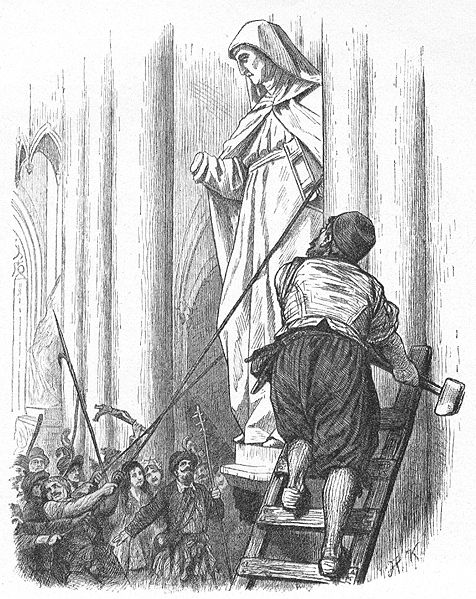
Iconoclasm as Heroism in Spenser's Book One of The Faerie Queene (an academic essay by an orthodox rebel)

In Book One of The Faerie Queene, being enamored with and thereby enslaved to the signifier rather than the signified seems to adequately identify Spenser's iconoclastic (and thus Protestant) tendencies in literature. Of course, it's not as simple as saying that Spenser was a Protestant in the absolute sense. His sympathies with medievalism greatly irritated his puritan and humanist peers, who could not understand why he wrote a story about knights and dragons and dwarves and other such papist trappings. Nevertheless, Spenser still allows for iconoclasm to be a kind of heroism, even while he maintains his medievalist leanings.

This is not a difficult inference to make. Practically every incarnation of evil in Book One, whether they be man or monster, is some kind of deceiver, spellbinder, or (if I may coin of term) a sign-weaver. Error spews forth false doctrines, Archimago weaves illusions, Duessa lives for deception, the House of Pride is a thin yet flashy veneer covering the dungeons of the dead, and Despair twists scripture in order to produce suicide.

In response to these "sign-weavers" is an apparently iconoclastic retaliation. Error is beheaded (defaced?), Duessa is stripped, and Despair's deadly interpretations are thwarted by Una's reiteration of true grace. Even the Dragon's death is described as erosion, which is a type of defacement: "So down he fell, as a huge rocky cliff / whose false foundation waves have washed away." It seems as though the weapons of the enemy are the deception of false images, and the weapon of holiness is an iconoclastic resolve guided by the word(s) of truth (viz., of Una).

As already stated, Spenser's use of "sign-weavers" as enemies is more than mere anti-papist propaganda: it is a statement about the intimate connection between evil and falsehood as well as between goodness and truth.  Holiness is not simply Protestantism; holiness is reality, living in and being guided by the real (esp. the highest real, i.e., God). Still, since The Faerie Queene was not ashamed to dabble in sensationalist elements (elements that had deep correlations to the everyday lives and experiences of the common folk of 16th century culture), asserting Spenser's use of iconoclastic heroes and image-bound villains is not an unfair interpretation.

-Jon Vowell (c) 2011