Showing posts with label Legalism. Show all posts

Tuesday, September 11, 2012

Homily Magnus: The High and Holy Striving (as preached by an orthodox rebel)

"For you are the temple of the living God. As God has said: 'I will dwell in them and walk in them, and I will be their God and they shall be my people.'" II Cor. 6:16b

It is the presence of God that counts in His children's lives and nothing else. The greatest danger is not always in what you're doing but in how or why you are doing it. Though motivation and intention are often less important than what actually happens, they can still be the greater threat because of their subtlety and insidiousness. They can creep in unawares and poison the most noble of endeavors with foul foundations, twisting them into paths of destruction. It is the fundamental intents of the heart that can lead to actions that we did not intend. Small, blinding miscalculations can bring the whole things crashing to the ground. That is the seriousness of the matter.

The life that seeks holiness and upright living apart from the presence of God in their life will become Pharisaical and legalistic without warning. Hard on themselves, impossible with others, and unable to avoid turning into anxious hypocrites. Meanwhile, the life that seeks some numinous religious experience apart from the presence of God in their life will fall into either a hollow and abstract mysticism or (what is worse) a paranoid and pathological occultism. Locked into themselves, blind to others, and unable to escape being useless statuary in God's trophy room (or being seduced by darker, more treacherous spirits). And the life that seeks social activism and cultural change apart from the presence of God in their life will become hopelessly knitted to the failing schemes of man, replacing God's wisdom and patience with all manner of man-made theories and solutions for utopia. Zealous for passing causes, vindictive of those who do not follow them, and incapable from avoiding fashionable fanaticism.

Do not misunderstand: this is not just a matter of giving God's presence a nod; any fool with a cause can claim, "God is with me!" Rather, this is a matter of recognizing and living out the recognition that without God's presence with you and within you, you can do nothing and are nothing (John 14:20; 15:4-5). It is not merely about knowing that He is there (for that can turn into a highly selfish solace), but rather about knowing that in all things He is first. In other words, it is not about principles and practices only but also priorities, the priorities that shape your principles and practices. And if God is not the priority of your life (knowing Him, loving Him, and trusting Him), then the well is already poisoned. No matter your intentions, the fundamental Intention is wrecked already. If God is not first, then He is not anything.

There is no way to do this perfectly, of course. The whole of the Christian life is this struggle to keep God first, but that is the point. You must struggle: groping and panting and fighting and desiring for the presence and beauty of the living God (Ps. 27:4; 42:1-2); and that struggle, that high and holy striving, must be the wellspring from which all other streams flow. We must ask ourselves the right questions: Do you abstain to honor Him? Contemplate to find Him? Work and create because you love Him? You must do it all for Him and no other goal, for there is no other goal except a chasing of the wind.

-Jon Vowell (c) 2012


Thursday, August 9, 2012

"The more things change...." (an observation and plea by an orthodox rebel)

"If any man does not love the Lord Jesus Christ, let him be accursed." I Cor. 16:22

First Corinthians is about ending divisions within the church. The theme of the whole book (stated in many different passages throughout it) is that all things must be done out of love in order to edify the brethren and save the lost. All prideful desires that tear the Body of Christ into sectarian pieces must be done away with, and the diversified unity of the Body must remain intact. Paul gives the Corinthians (and us) no grounds for division except for one: if Christ is not the center of someone's life, then that person is not a Christian (no matter what other qualities they possess). For Paul, Christ was everything: the foundation (I Cor. 3:11) and direction (Col. 2:6-7) of every believer's life. If one did not love Christ, to the extent that He is the absolute center of every facet of their existence (their hopes and dreams and actions and opinions), then they have no fellowship with Christ. That is how serious the matter was and is.

On the whole, we don't take that matter as seriously anymore. We think we do, but we don't. Jesus is not the center of our lives. Perhaps He is a part; some vital, peripheral element, but not the center. Regardless of our talk or walk, Christ is always subjugated to some whim or passion of our own, a consistent phenomenon that seems to be the one true plague of Christianity. In our parent's generation, Christ was equated with holy living (a true if incomplete notion), and soon He became subjugated to pious-sounding, man-made moralisms. To the broken and lost, He became a menace rather than a strongtower of safety, and the effects of this linger to this day.

Our generation has done no better, however. We equate Christ with loving service (another true yet incomplete notion), and soon He becomes subjugated to pious-sounding, man-made movements. And what, exactly, have we gained by this change? To the lost and broken, Jesus is little more than a handout or a bumper-sticker slogan and not Savior or Lord. It is a supreme tragic irony that we have two different generations with two different sets of ideas and activities and yet they commit the same fundamental error: Jesus is not the center. He is an assistant or homeboy or example or taskmaster or poster-child or convenient bludgeon, but never the center. With our own hands we drown Him in the midst of our own manias.

You who boast of living lives of morality and purity, abiding solidly in dogmatic perfectionism: do you pursue such a life out of pride and the gratification of your own ego? To save face before the eyes of others? Or do you pursue it because you love Jesus? And you who live to help the poor and oppressed, standing on the frontlines with pickets and posters in hand: do you rage against the machine because you hate your parent's generation? Because you have a political ax to grind? Or do you do it because you love Jesus? In spite of whatever good intentions we have, anything done for any reason other than a true, deep love for Jesus is dead wrong, a reaping of the wind. May God have mercy on us all and cleanse us of the motives that come in such clever disguises to supplant our Lord in our hearts.

-Jon Vowell (c) 2012


Tuesday, August 9, 2011

Legalists and Shades of Grey: Why everyone is wrong (as explained by an orthodox rebel)

The following is a comment I dropped over at another blog. My comment was in relation to a discussion about legalists and literature, viz., how they usually approach all literature from a very narrow point-of-view that prevents the literature from having any positive growth and/or change in their life. I agreed with most of what was said, up until a certain paragraph. That was where the fun began.

"For every [legalist], plot can be boiled down to these elements: Someone is right. Someone is wrong. And Someone is bound to be damned if they keep it up. That's all that matters. Insight into things like life, love, pain, greed, sacrifice, hate, bravery, desire, and the common human condition are just so much window dressing [to them]." (by "Darrell," the site director for the blog)

I take issue with this statement, Darrell, though not for the reasons that you may think.

I am an English major (having just received my Masters last year) and an aspiring author (I'm working through my first novel even as we speak), and I completely agree with your main premise: [Legalists] do not get out of books what they're supposed to get out of books (viz., an enlightenment and enlargement of the mind and soul) because they come to every book with a narrowly constructed box that they try to jam everything into kicking and screaming. The world is larger than they suppose, and God larger still. This, we agree on.

However, I disagree that that box is simply "someone's right and someone's wrong and the latter will be damned if they don't turn around." Rather, I think the box is more "someone's right in my specific way and someone's wrong in my specific way and the later will be damned if they don't turn around in my specific way." [Legalists] have their man-made preconceived notions about what is "holy" and what is "damnable," and that is their error: their moral compass has been tinkered with by human hands, and only an act of God can blast the thing apart and rebuild it correctly. In short, their moral compass is skewed and cramped; that is their flaw. I know that you (and everyone here [on your blog]) would soundly agree with that.

Your actual statement, however, seems to imply that the [legalist's] flaw is not that their moral compass is skewed, but rather that they have a moral compass at all. Though I am sure that that was not your overt meaning, I still feel the need to caution against such implications.

Shades of grey do serve a dramatic purpose (both in novels and real life), but our world is not simply shades of grey anymore that it is simply black and white. In fact, if there were no "black and white," then the very concept of "shades of grey" would lose all meaning.

Simply put, "Someone is right [and] Someone is wrong [a]nd Someone is bound to be damned if they keep it up" may be simplistic, but it is still true, at least in this regard: "Except you repent, you will all perish" (Luke 13:3). The truth is that there is someone who is "right" and someone who is "wrong": God is right, and we are wrong; and unless we repent, we will perish. It is either-or. There is no middle ground.

I write this knowing full well that ninety-nine percent of everyone here will agree in some degree with what I am saying, but I still see this as a necessary caution. In correctly pointing out the suffocating claustrophobia that passes for [legalist] moralism, we must not turn and commit the opposite yet equal error of jettisoning black and white morality in its entirety. Shades of grey do exist, and thus we must approach others with compassion and understanding; but black and white exist too, and thus our compassion must include Jesus' warning: without repentance towards God, there is only damnation.

-Jon Vowell (c) 2011

Wednesday, May 18, 2011

Homily 29: How to Be (as preached by an orthodox rebel)

"If ye know these things, happy are ye if ye do them." John 13:17

Happiness is invariably linked to obedience. We must rescue this concept from the legalists and moralists of the world. They have made obedience an arbitrary rule-keeping, reducing it to an inevitable drudgery. If there is any happiness, it is artificial, and there is many a legalistic church full of fake, artificial happiness. Outwardly is all smiles and shouts, but inwardly is a cancerous ennui. Life with God becomes a chore to be done, happiness and joy be damned. This is the view that most people have of obedience, and we must rescue it from such a horrid corruption.

God is Creator: He made everything. More to the point, He is our Creator: He made us. This is much more than a matter of matter. If God has names for all of the stars (Ps. 147:4), which physically are just balls of burning gas, He certainly has names for all of us, a name which He shall reveal to us one day (Rev. 2:17). That is a point that we must not miss: our identity is bound up in God, an identity whose full disclosure will come to us when we see Him face to face (I John 3:2). At the very least, we can gather for now that we are a creature: not in a bestial sense, but in the sense of something that is made. We are from the hand of a Maker; that is (in part) who we are. That is where we belong. It is our "place," so to speak, and identity is about place, viz., the place where we "fit," like a puzzle piece, or a bone in its socket. The whole history of human Sin (even to this day) can be seen as humanity trying to find their place without God, which is a futile endeavor. If we want to know who we are, then we must go to the One who made us.

This sheds a new light on God's commands. He is not just giving us rules, the arbitrary assignments of a divine monarch. Rather, He is teaching us how to be. The commands of God are the precious communique from Creator to creature where the former tells the latter who they are, who they ought to be (for the very nature of the Fall is that we are not who we ought to be). This is why obedience is happiness: when we obey the Creator, we are being who we are, who we ought to be and were meant to be. We have found our place, our identity, our home. And there's no place like home.

-Jon Vowell (c) 2011


Thursday, March 10, 2011

Homily 25: Unnecessary Divorces: The Errors of both Fundamentalism and the Emergent Church (as preached by an orthodox rebel)

"You are wrong because you know neither the Scriptures nor the power of God." Matt.22:29

"On these two commandments depend all the Law and the Prophets." Matt. 22:40

Christianity, in coming from and leading to God, is the holistic religion. Everything finds its place within its framework and context. Why, then, do we continually find the need to break it up and apart? Why do we always tear asunder what God has joined together? Many errors crop up in the Church, but what is worse than the errors themselves is the hysteria they create that drives people to opposite yet equal errors. Thinking we've found the center, we've merely found another extreme. Such a circus can be see even to this day.

In the second half of Matthew 22, Jesus is questioned first by the Sadducees. The Sadducees were the Jewish skeptics, the post-modernists of their day. Post-modernism, of course, is nothing new. It is merely the old skepticism rehashed, recycled, repackaged, and regurgitated. The Sadducees were ancient pomos. If you don't believe it, then just look at the question that they posed to Jesus (Matt. 22:24-28). It is philosophically tangled. It is ironic. It is subversive. The Sadducees did not believe in the resurrection, and thus their question is deconstructive: it is trying to expose tensions in the resurrection narrative that will reveal it to be artificial. Jesus responds by throwing down a radical notion of his own (Matt. 22:30) that effectively subverts their subversion, and then He quotes the Pentateuch at them (Matt. 22:31-32), the only part of the Old Testament that they liked (similar to how modern day pomos like the gospels but not the rest of the New Testament).

Before Jesus answered the Sadducees, however, his initial response laid down His primary position, His starting place for the whole issue. He exalted both the principles of God ("the Scriptures") and the practices of God ("power of God"). He starts his response by asserting that He holds these two things together. There are many people today (both skeptical and credulous) who will not abide such a union. Some want the principles only, becoming scrupulous scholars and dogmatic doctrinaires. They have systematized the whole with impeccable perfection. God, however, is merely an abstract concept to them, as remote as the furthest star. Despite their tremendous elucidation, one wonders if they truly believe all of their humbug. Meanwhile, others want only the practices, to see angels and demons behind every bush, and fire fall from heaven everyday. They dismiss doctrine as mere shackles, and thus confuse every odd occurrence as having massive spiritual import. Despite their fiery credulousness, one wonders if they even know what they're talking about. The resulting spirituality of the former is a stifling deadness and petrification. The resulting spirituality of the latter is religious insanity and chaos. Both have divorced what Jesus never divorced.

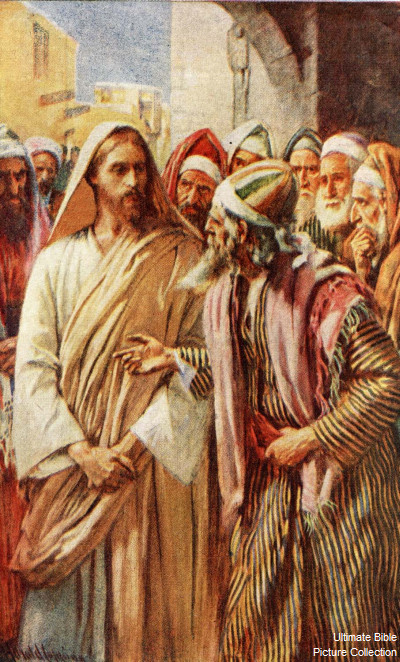
The Pharisees catch wind of the unholy smackdown that Jesus laid upon the Sadducees, and they decide to throw their own hat into the ring. Of course, the Pharisees were the stuffy fundamentalists of their day, again a very old and very common occurrence. The stagnant conservative and the anarchistic progressive are as old as the hills. The Pharisees, being good solid fundamentalists, asked Jesus a very straightforward, simple, yet profoundly doctrinal question (Matt. 22:36). Jesus, in return, provided a very straightforward, simple, yet profoundly doctrinal response (Matt. 22:37-40). Per His usual tactic when dealing with the Pharisees, He attacks their brand of religionism by stating what they already know (vs. 37-38) but then tacking on what they have missed (vs. 39). The Pharisees had "loving God" down pat (or so they thought), but as Jesus pointed out many times before and after this incident, their love towards people was non-existent. Like the Sadducees, in answering their question He also rebuked them.

Also like the Sadducees, Jesus lays down in His answer a twin set of ideas that He holds together in tandem that the Pharisees wanted to separate. He summarized the entirety of their precious "Law and the Prophets" under two commands: love God and then love people. Again, there are many (both credulous and skeptical) who will not abide such a union. For some, the only true command is to love God, to develop the private spirituality of the devotional and the closet. Other people are merely distractions, having no real value in and of themselves other than being teaching tools to learn more about God. They become means to an individual end, no more and no less. Meanwhile, for others, the only true command is to love people, to develop the public spirituality of missional friendship. "Quiet Time" and other devotional trappings are merely stumblingblocks to religious work and activity in the community. Even church becomes a distraction, having no real value in and of itself other than being a convention center to gather more people. The resulting spirituality of the former is an isolated occultism that grows weary of others. The resulting spirituality of the latter is an endless guilt-induced sense of doing that also grows weary of others. Again, they have divorced what Jesus never divorced.

All of these silly, unnecessary divorces that we see back then and still today are fundamentally anti-incarnational. In some way or another, they deny "the Word made flesh". For some, "the Word" in its uncreated exaltation is everything: doctrinal discovery followed by a spiritual introspection that never learns to work itself out "through the fingertips." For others, "the flesh" in its rugged reality is everything: continual immersion and outward activity that has no greater foundation than our own emotional sentimentalism. Both ways are incomplete, and thus are wrong. Both ways have partial truth, and thus are dangerous. Each can bash the others weakness from their own strong point. The former can bash the latter for their "worldliness" and scriptural compromise, while the latter can bash the former for their "insensitivity" and lack of concern for the Kingdom of God. Both positions are right in pointing out the others error. In other words, both positions are right, thus both positions are wrong.

Those who claim to be Christians and those who claim to be "Christ-followers" or "emerging" (or whatever) both need to reexamine what their Master taught. It is not a choice between God's principles or God's practices, not love God or love people, neither is it half and half. The true "Christ-like" life knows the principles of God and thus believes in the practices of God. The true "Christ-like" life passionately and unapologetically loves God and thus passionately and unapologetically loves people. There is no severance or neglect. Both sides of the coin are intimately connected and burning at full capacity. It is the true incarnational life, "the Word" made "flesh". May we from henceforth strive to cease from divorcing the two.

-Jon Vowell (c) 2011


Tuesday, January 18, 2011

Homily 21: God > Temple (as preached by an orthodox rebel)

"I tell you, something greater than the temple is here." Matt. 12:6

The Pharisees rebuked Jesus' disciples for supposedly breaking the Law. Jesus, in turn, rebuked the Pharisees for not seeing the One whom the Law points to. The problem with a Pharisee is not that they are religious. Their problem was that their religion was greater than God. For them, the shadow trumped the substance, and the Law (and its trappings) where higher even than God Himself. This was not a statement of logic that they ever spoke. It was a fact of experience that they continually lived. God walked in the flesh amongst them for three years, but they could not see the Lawgiver for the Law. That which was meant to lead to God had taken God's place, and now the very means by which they were to see became their blindness.

A Pharisee, then, is not a legalist; a Pharisee is an idolater. Antinomian types (and other "gutless-gracers") can be just as much a Pharisee as a legalist. That is because a Pharisee is not one who makes rules about how to get to God, but rather rules about who God is. They set up an image of God based on their own logic and/or experiences and then say that the matter is settled forever under heaven. Legalists certainly come from such stock, but so do antinomians.

We all create an image of God out of our logic and experiences. It is not wrong per se; it is the natural way that we comprehend things. What is wrong is when we say that our image is the end of the matter, and defend it to the death against all comers, even God Himself. That is the way of the Pharisee, the idolater. Our image has become graven--set in stone. We must not be surprised when God brings the hammer to them, breaking our self-made and misused icons until we finally reach reality.

-Jon Vowell (c) 2011