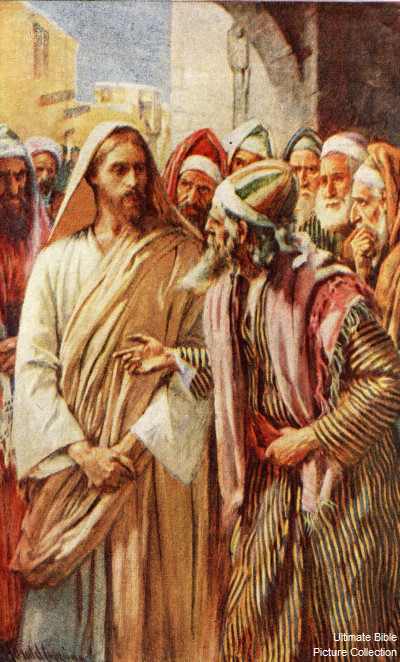
"You are wrong because you know neither the Scriptures nor the power of God." Matt.22:29
"On these two commandments depend all the Law and the Prophets." Matt. 22:40
Christianity, in coming from and leading to God, is the holistic religion. Everything finds its place within its framework and context. Why, then, do we continually find the need to break it up and apart? Why do we always tear asunder what God has joined together? Many errors crop up in the Church, but what is worse than the errors themselves is the hysteria they create that drives people to opposite yet equal errors. Thinking we've found the center, we've merely found another extreme. Such a circus can be see even to this day.

In the second half of Matthew 22, Jesus is questioned first by the Sadducees. The Sadducees were the Jewish skeptics, the post-modernists of their day. Post-modernism, of course, is nothing new. It is merely the old skepticism rehashed, recycled, repackaged, and regurgitated. The Sadducees were ancient pomos. If you don't believe it, then just look at the question that they posed to Jesus (Matt. 22:24-28). It is philosophically tangled. It is ironic. It is subversive. The Sadducees did not believe in the resurrection, and thus their question is deconstructive: it is trying to expose tensions in the resurrection narrative that will reveal it to be artificial. Jesus responds by throwing down a radical notion of his own (Matt. 22:30) that effectively subverts their subversion, and then He quotes the Pentateuch at them (Matt. 22:31-32), the only part of the Old Testament that they liked (similar to how modern day pomos like the gospels but not the rest of the New Testament).
Before Jesus answered the Sadducees, however, his initial response laid down His primary position, His starting place for the whole issue. He exalted both the principles of God ("the Scriptures") and the practices of God ("power of God"). He starts his response by asserting that He holds these two things together. There are many people today (both skeptical and credulous) who will not abide such a union. Some want the principles only, becoming scrupulous scholars and dogmatic doctrinaires. They have systematized the whole with impeccable perfection. God, however, is merely an abstract concept to them, as remote as the furthest star. Despite their tremendous elucidation, one wonders if they truly believe all of their humbug. Meanwhile, others want only the practices, to see angels and demons behind every bush, and fire fall from heaven everyday. They dismiss doctrine as mere shackles, and thus confuse every odd occurrence as having massive spiritual import. Despite their fiery credulousness, one wonders if they even know what they're talking about. The resulting spirituality of the former is a stifling deadness and petrification. The resulting spirituality of the latter is religious insanity and chaos. Both have divorced what Jesus never divorced.

The Pharisees catch wind of the unholy smackdown that Jesus laid upon the Sadducees, and they decide to throw their own hat into the ring. Of course, the Pharisees were the stuffy fundamentalists of their day, again a very old and very common occurrence. The stagnant conservative and the anarchistic progressive are as old as the hills. The Pharisees, being good solid fundamentalists, asked Jesus a very straightforward, simple, yet profoundly doctrinal question (Matt. 22:36). Jesus, in return, provided a very straightforward, simple, yet profoundly doctrinal response (Matt. 22:37-40). Per His usual tactic when dealing with the Pharisees, He attacks their brand of religionism by stating what they already know (vs. 37-38) but then tacking on what they have missed (vs. 39). The Pharisees had "loving God" down pat (or so they thought), but as Jesus pointed out many times before and after this incident, their love towards people was non-existent. Like the Sadducees, in answering their question He also rebuked them.
Also like the Sadducees, Jesus lays down in His answer a twin set of ideas that He holds together in tandem that the Pharisees wanted to separate. He summarized the entirety of their precious "Law and the Prophets" under two commands: love God and then love people. Again, there are many (both credulous and skeptical) who will not abide such a union. For some, the only true command is to love God, to develop the private spirituality of the devotional and the closet. Other people are merely distractions, having no real value in and of themselves other than being teaching tools to learn more about God. They become means to an individual end, no more and no less. Meanwhile, for others, the only true command is to love people, to develop the public spirituality of missional friendship. "Quiet Time" and other devotional trappings are merely stumblingblocks to religious work and activity in the community. Even church becomes a distraction, having no real value in and of itself other than being a convention center to gather more people. The resulting spirituality of the former is an isolated occultism that grows weary of others. The resulting spirituality of the latter is an endless guilt-induced sense of doing that also grows weary of others. Again, they have divorced what Jesus never divorced.

All of these silly, unnecessary divorces that we see back then and still today are fundamentally anti-incarnational. In some way or another, they deny "the Word made flesh". For some, "the Word" in its uncreated exaltation is everything: doctrinal discovery followed by a spiritual introspection that never learns to work itself out "through the fingertips." For others, "the flesh" in its rugged reality is everything: continual immersion and outward activity that has no greater foundation than our own emotional sentimentalism. Both ways are incomplete, and thus are wrong. Both ways have partial truth, and thus are dangerous. Each can bash the others weakness from their own strong point. The former can bash the latter for their "worldliness" and scriptural compromise, while the latter can bash the former for their "insensitivity" and lack of concern for the Kingdom of God. Both positions are right in pointing out the others error. In other words, both positions are right, thus both positions are wrong.

Those who claim to be Christians and those who claim to be "Christ-followers" or "emerging" (or whatever) both need to reexamine what their Master taught. It is not a choice between God's principles or God's practices, not love God or love people, neither is it half and half. The true "Christ-like" life knows the principles of God and thus believes in the practices of God. The true "Christ-like" life passionately and unapologetically loves God and thus passionately and unapologetically loves people. There is no severance or neglect. Both sides of the coin are intimately connected and burning at full capacity. It is the true incarnational life, "the Word" made "flesh". May we from henceforth strive to cease from divorcing the two.
-Jon Vowell (c) 2011