Thursday, October 7, 2010

Homily 14: On the Wilderness and Faith (as preached by an orthodox rebel)

"To Him who led His people through the wilderness...." Ps. 136:16a

The wilderness is not a fun place to be. It is the strenuous and expansive dry patch between the explosive bookends of the Exodus and the Promised Land. There are no  obvious mountaintop experiences; just meat and manna at the moments of crisis and unbelief. Patience will dry up like waters in the desert. A terrible restlessness and fear will strive to shake your soul apart: perhaps God made a mistake? Perhaps we should have stayed in Egypt: better to be in a stagnant stability than this howling emptiness. Therein lies the many dangers, toils, and snares. You are beset on every side by strange fire and foreign mistresses, tempting you with false hopes and homes. The vision of the Promised Land, so clear at one point, now feels like it was a generation ago. You're not even sure what you're doing anymore, and you are afraid. No, the wilderness is not a fun place.

It is also, however, an inevitable and necessary place. No high and holy vision or calling of faith comes without the suffering of its birth, and that suffering will always entail the testing of that faith. God will see your calling come to fruition, but only after you learn to fully let go and trust in Him, learn that things are only done by Him (Zech. 4:6), you can do nothing without Him (John 15:5), and it is He that will complete the work (Phil. 1:6). You cannot face the Promised Land with all its wars until you firmly stand upon the solid truth that says, "God is God and I am not." If you cannot trust God in the wilderness, then where can you trust Him? Certainly not when the pressure is on and the crises culminate into climax. We must let the wilderness take its toll. We are not fit for the future until we do.

-Jon Vowell (c) 2010


Thursday, September 23, 2010

On the Offensiveness of True Christian Living (as written by an Original Orthodox Rebel)

The following is the September 22nd entry in the Oswald Chambers devotional Daily Thoughts for Disciples. Though well known for his popular devotional My Utmost for His Highest, many remain unaware of the bulk of Chamber's teachings (almost all about Christian living), found in some 30 books produced from his writings and lectures. Because of this, Chambers is ironically the best kept secret of Christianity. The following devotional entry is actually an excerpt from his book The Servant as His Lord.

When the Spirit of God comes in, we begin to realize [that] everything that is not of God has to be turned clean out. People are surprised and say, "I was told God would give the Holy Spirit to them that ask; well, I asked for the Holy Spirit and expected that He would bring me joy and peace, but I have had a terrible time ever since." That is the sign that he has come. He is turning out the "moneychangers and the cattle," the things that were making the temple [i.e., your body] into a trafficking place for self-realization.

We soon find why the gospel can never be welcome. As long as we speak winsomely about the meek and gentle Jesus and the beautiful ideas the Holy Spirit produces when He comes in, people are captivated, but that is not the gospel. The gospel does away with any other ground to stand on than that of the atonement. Speak about the peace of heaven and the joy of the Lord, and people will listen to you; but tell them that the Holy Spirit has to come in and turn out their claim to their right to themselves, and instantly there is resentment: "I can do what I like with my body. I can go where I choose."
 
The majority of people are not scoundrels and criminals, living in external sin. They are clean-living and respectable, and it is to such that the scourge of God is the most terrible thing, because it reveals that the natural virtues may be in idolatrous opposition to God.


Wednesday, September 22, 2010

Time and the Engineering of God (the musings of an orthodox rebel)

"Arise, shine...." Is. 60:1

What are you doing with the time that you have been given, with the moments that God has engineered in your life? I am not talking about some general, abstract sense of "your life," but rather your immediate circumstances, the here and now. Are you filling up these current moments with what God has given you to do (no matter how great or small), or are you wasting time by moping and whining about what "should" or "could" be (or even what will be)? When it comes to practical energies and endeavors, "should" and "could" are always a snare. When action is called for, it is no good to suddenly deliberate about whether or not circumstances should or could be better and subsequently whether or not your efforts will succeed. Such concerns will leave you paralyzed, and thus make the here and now even more frustrating. You must not fix your focus on the formless future; keep it on the present moment with its more defined lines and edges. Keep your energies on the right now where you can actually do something (even small things); tomorrow is none of your business (Matt. 6:34). Most importantly, keep your eyes on God, on His presence and promises.

What glorious wasters of time we are! God has called us to a specific purpose. He then engineers our immediate circumstances to aid (in some way) in that purpose. However, we wrongly consider our circumstances. We see them as a detriment to God's purpose, or we don't see them at all and thus don't capitalize on them. In either case, we have set our gaze on some imagined future situation that we feel we must wait for, and as a result we get stuck in the mud. "Oh, but I must wait until this or that falls into place before I can do anything." If you don't start doing something(s) now in the small and quiet moments, then you will surely do nothing when ideal circumstances come, if they come at all. "Oh, but what's the point? I am not doing anything that matters right now." If that is so, then it is because you are not doing it. Everything in our lives is engineered by God to fulfill His purpose in our lives (Rom. 8:28). If you say that you believe that, then what are you doing with the current moments that you have been given? How are you using the tools at your disposal, even (and especially) the small or strange ones? If you are blessed right now with inordinate free time, are you filling it up on some level with what you are meant to do? If you are in odd or hard circumstances right now, what are you learning? Are you learning? Or are you filling up your time with nothingness while you simultaneously cry about the nothingness?

Epithet: Do not waste one drop of time that God has given to you. It was given for a reason.

-Jon Vowell (c) 2010


Homily 13: On the Righteous and Awakening (as preached by an orthodox rebel)

"Unto the upright there arises light in the darkness...." Ps. 112:4a

The righteous life is not a matter of smug piety and self-satisfaction; rather, it is a matter of seeing things as they are. The whole world lies in darkness, and fallen humanity stumbles about. The redeemed of the Lord are simply those whom light has shined upon, and now they can see. Their walk is now marked with flashes of realization and awakening. Reality becomes clearer and clearer. At long last, what's truly important can be clung to, what's non-essential can be held loosely, and what's evil can be properly abhorred. Where once we could only make half-guesses and hope for the best, now we receive true knowledge. Where once we were blind, now we see.

This clarity is not absolute and instantaneous. Reality is not comprehended in an instant nor in entirety. How can it be? God is Reality, the most real, and He is beyond absolute comprehension (Rom. 11:33). The righteous life does not mean an end to mystery. What it does mean is that "there arises light in the darkness," momentary yet momentous illuminations that give us the clarity that we desperately need at that moment. For now, we know in part; one day, we will know in full (I Cor. 13:9-12). Until then, let us praise the God who lights our night with His presence and truth, the God who is "gracious and full of compassion and righteousness" (Ps. 112:4b).

-Jon Vowell (c) 2010


Wednesday, September 8, 2010

How Journalism Misses the Point (a prophetic aside by an Original Orthodox Rebel)

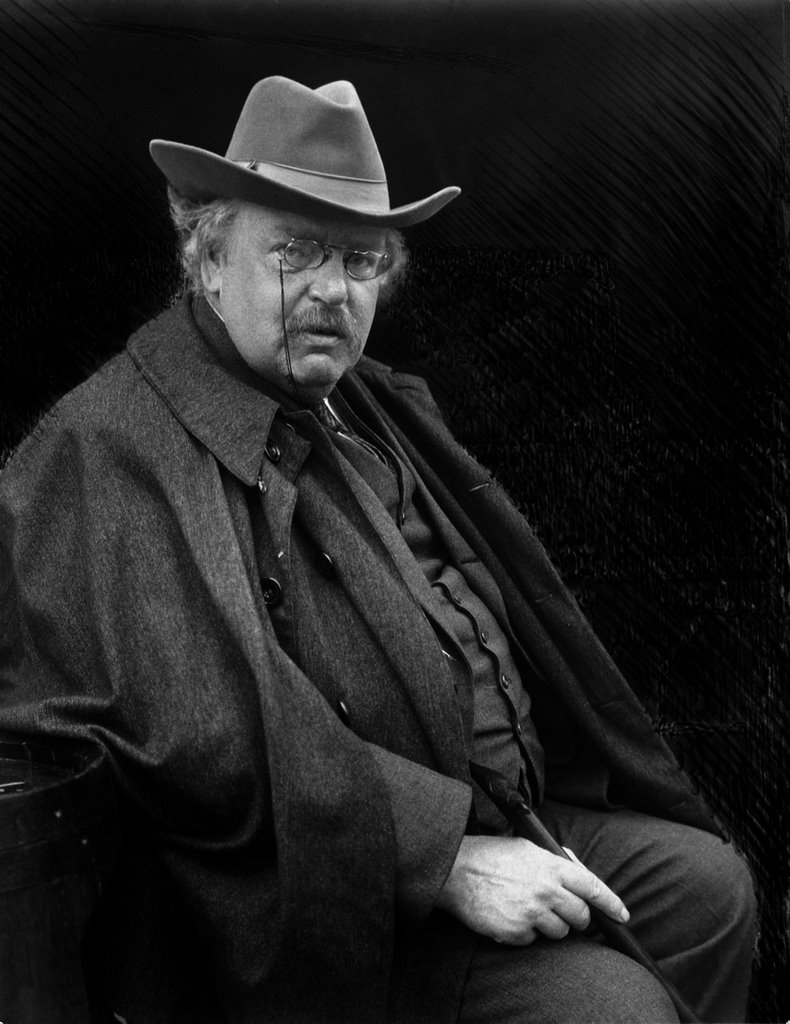
The following is from chapter 4 of Chesterton's novel The Ball and the Cross:

It is the one great weakness of journalism as a picture of our modern existence that it must be a picture made up entirely of exceptions. We announce on flaring posters that a man has fallen off a scaffolding. We do not announce on flaring posters that a man has not fallen off a scaffolding. Yet this latter fact is fundamentally more exciting, as indicating that that moving tower of terror and mystery, a man, is still abroad upon the earth. That the man has not fallen off a scaffolding is really more sensational; and it is also some thousand times more common. But journalism cannot reasonably be expected thus to insist upon the permanent miracles. Busy editors cannot be expected to put on their posters, "Mr. Wilkinson Still Safe," or "Mr. Jones, of Worthing, Not Dead Yet." They cannot announce the happiness of mankind at all. They cannot describe all the forks that are not stolen, or all the marriages that are not judiciously dissolved. Hence the complete picture they give of life is of necessity fallacious; they can only represent what is unusual. However democratic they may be, they are only concerned with the minority.


Saturday, September 4, 2010

On Despairing in a Bookstore: Prose Edition (the musings of an orthodox rebel)

(Note: Find and read the poem editions here and here.)

"Give us help from trouble, for vain is the help of man. Through God we shall do valiantly, for it is He that shall tread down our enemies." Ps. 108:12-13

I have often found bookstores to be terrifying places. Apart from being black holes for a certain unnamed blogger's time and money, they can create an overwhelming sense of smallness. Within those wooden halls (whose walls are bleached with the stench of coffee), there is a seemingly infinite amount of thought and opinion floating around, coalescing together into a monstrous edifice of worldly wisdom and consideration. Before such a modern tower of Babel, one can feel extremely tiny and alone. I am not referring to that childish notion about how your individual beliefs could possibly be true before such a saturated intellectual marketplace (for mere vast numbers of counter claims and opinions do not negate the truthfulness of any one idea). What I am referring to is a sense of impotence and hopelessness before it all: even if what you believe is true, what does it matter? The sea of human opinion is vast and varied beyond any possible charting. How can you possibly hope to make any noticeable dent in it?

As already stated, this is not a problem with unbelief but rather despair. If you lose faith in one belief, then you can (and will) exchange it for another and move on with your life. If, however, you still have faith but feel as though it is faith in a lost cause, then what can you do? You know that Christ alone has the words of life, and thus there is really nowhere else to go (John 6:67-68); yet the darkness around your little circle of light seems impenetrable, an unholy mountain range of impassable crags and impossible caves. In short, you have great faith in what you believe but no faith in making it matter. Any and every escapade into the dark seems a frustrating failure, leaving you to "reel to and fro, and stagger like a drunken man" until you are "at [your] wit's end" (Ps. 107:27). Your feelings of smallness and loneliness are confirmed, and they spill over into feelings of uselessness, with all ending in despair.

It is at these points of desolation and discouragement that we must remember: "vain is the help of man," including ourselves. If we are despairing right now in the face of looming and accumulated public thought and opinion, then it is because we see the fight as ours and not God's. It is through Him and Him alone that "we shall do valiantly." I am not saying that we will knock the whole giant monolith of counter/non-Christian opinion over in a night (nor am I not saying that). What I am saying is that whatever our impact upon it (be it great or small), it will only come through God, not us. There is a thing that He has given each of us to do, some sharp sword to stick in the side of the spirit of the age and the prince of this world, a sword specific to each of us. If we see that sword as a matter of our own strengths and abilities, then we will feel smothered beneath the shadow of the world. However, if we "seek the Lord and His strength," then we will rejoice (Ps. 105:3-4) and go singing into the dark.

Epithet: Let the unquenchable joy of the Lord be your strength and His unconquerable strength be your joy.

-Jon Vowell (c) 2010


Monday, August 30, 2010

Homily 12: On Service and Love (as preached by an orthodox rebel)

"Serve the Lord with gladness...for the Lord is good...." Ps. 100:2, 5

The only true and proper service is one done out of love for the object of service. Service itself is good, but only as a means, not an end. Once it is done for itself (i.e., service "in the raw"), it falls apart. It will quickly wear thin and consequently wear out the one who is serving. If they find some strength of ego or conviction to keep going, then they will become hard and cold in their service. Thus, service reveals itself to be a wonderful tool but a terrible god. It can steal all the joy out of life and love.

It is the same thing in regard to God. We do not serve Him for service's sake; we serve Him because (1) He is Lord and (2) He is good. God's quality and character are to be our focus; consequently, service cannot be the center: God is. He is to always be the center, and the instant that something else takes His place (e.g., service), life becomes a disaster. We are serving God for the wrong reasons, and thus are serving the wrong god. Serve the Lord, not for the sake of mere service, but because He is good, because His mercy is everlasting, because His truth endures forever (vs. 5). When you are caught up in love for God (for who He is and what He has done), service becomes a means to express love, and in that context it becomes as easy as breathing.

It should be obvious by now that service is for our benefit, not God's. He needs nothing; He wouldn't be God if He did. Like worship, service is about awakening to reality, i.e., really seeing who God is and who we are in return. The result of such a heavenly vision is loving God more (and therefore serving Him more).  Thus, service is a natural result of desiring closer communion with Him. Anything that sets our focus and affections on God, causing us to draw closer to Him, is good for our souls, because we are poor and needy while He is all-sufficient.

-Jon Vowell (c) 2010


As Kingfishers Catch Fire (poetry from an Original Orthodox Rebel)

The following is a poem by Gerard Manley Hopkins. Though classified as a Victorian poet, many people see Hopkins as a proto-modernist poet, and he served as an inspiration for the likes of Yeats, Auden, and Eliot. The following poem shows not only his unique and beautiful use of rhyme and structure but also displays his notion of "inscape," a Psalm 19-esque philosophy that seeks to see and capture the glory of God that is inherent (and buried) within His creation.

As kingfishers catch fire, dragonflies draw flame;
As tumbled over rim in roundy wells
Stones ring; like each tucked string tells, each hung bell's
Bow swung finds tongue to fling out broad its name;
Each mortal thing does one thing and the same:
Deals out that being indoors each one dwells;
Selves--goes itself; myself it speaks and spells,
Crying What I do is me: for that I came.

I say more: the just man justices;
Keeps grace: that keeps all his goings graces;
Acts in God's eye what in God's eye he is--
Christ--for Christ plays in ten thousand places,
Lovely in limbs, and lovely in eyes not his
To the Father through the features of men's faces.


What Moves You: The Premium Mobile Question (an orthodox rebel's post-script to "God Interrupted")

"The Lord reigneth; let the people tremble...." Ps. 99:1a

If there is one thing and one thing only that should garner our awe and reverential fear, it is the God who is and who reigns. His presence, promises, and power should be what holds the most weight in our vision of reality, yet look at us. Look at the things that we give more weight to than God; look at what we give our awe and fear to: jobs and money, school and performance, marriage and relationships, people and places of all shapes and sizes. In and of themselves, such things are good; but the instant that something, anything counts for more than God in our lives is the instant that that thing (and our lives) go awry. We have put everything out of order: what we placed on top was never meant to be on top.

That is the great irony of the situation. We think that we are doing ourselves a favor by giving all of our focus and concern to finding that job, finishing that paper, finding this or that man or woman. In truth, when we give the entirety of our energies to those things, we have set them at the center of our universe, making them idols and hard taskmasters. Consequently, everything falls apart. We have done ourselves no favors. Whenever we put something that's not God in God's place, no matter how good or noble it is in and of itself, it becomes demonic, i.e., it corrupts and destroys the whole edifice of our lives, including itself.

-Jon Vowell (c) 2010


Thursday, August 26, 2010

You Tell Me (poetry of an orthodox rebel)

"I hate the auto dripping drag that cuts across the grind
To where I see at the typing tree some fellows, friends of mine.
I do not like them, Sam I am, said Fred whose family flocks
To see the sightly tripping tree and laugh at all the locks.

The doors are barred and drapes are pulled across the eerie eye
Of precious fiendish peeping toms who love their wheat and rye.
Drinks dull and dowdy pout the pull of waves that wipe the shore,
And ere we glint the air a hint, we wonder what they're for.

My friend right there with the fishbowl face, he smiles a sickly frown
Found only in the friar's den on the other side of town.
And if we grip our pick-up-sticks and shuffle out the side,
We'll crash into our comely crew and there we will have lied.

And up and out and over still the showers of the main
Will pierce our polly-crackered heads with heaps of it again.
Until the tow'ring tide and sun surrender us their skins,
I'll never cross the drag or grind and go and see my friends."


-Jon Vowell (c) 2010